Speaker Diarization
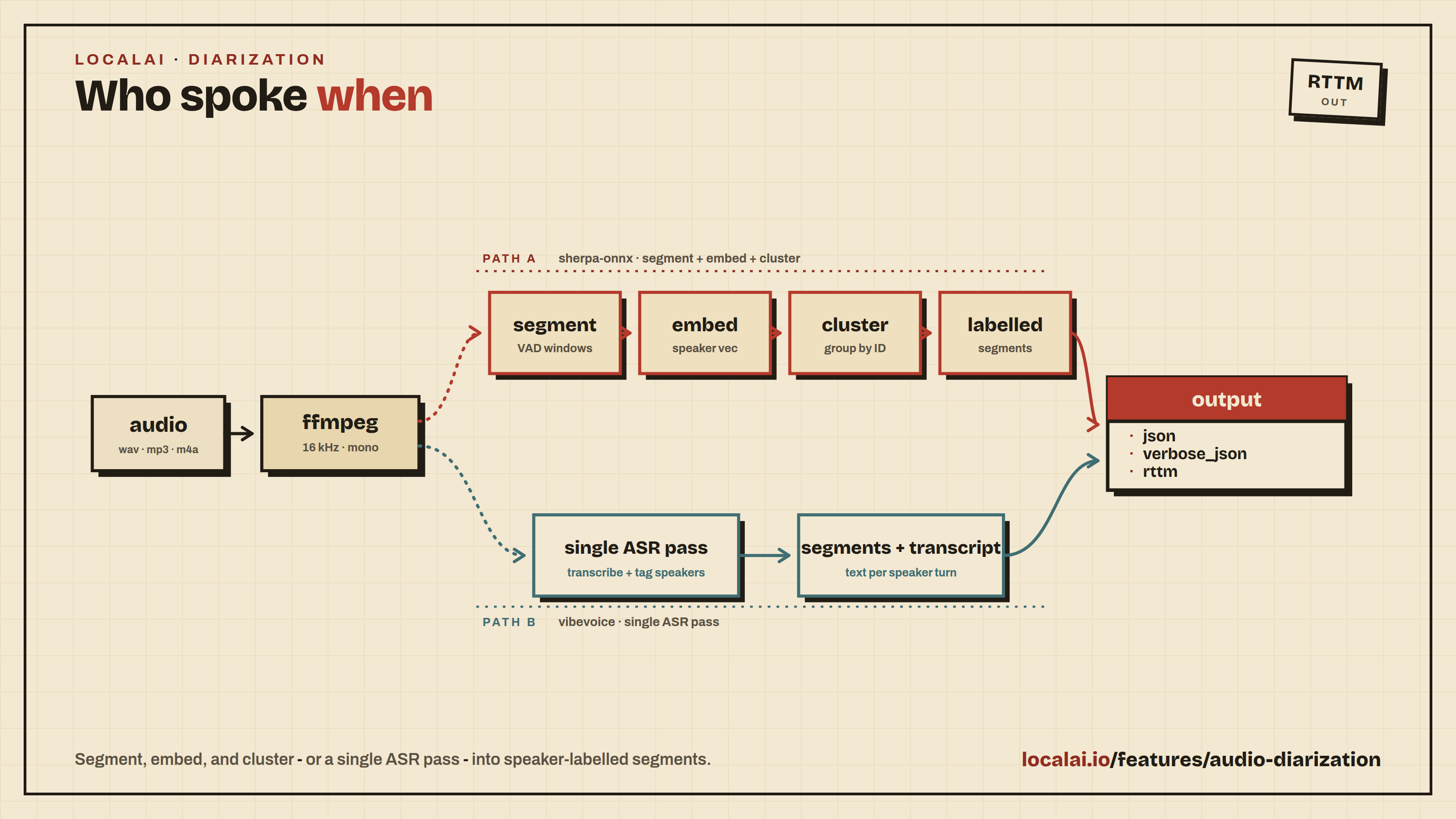
Speaker diarization answers the question “who spoke when?” - given an audio clip with multiple speakers, it returns time-stamped segments labelled with a stable speaker ID (SPEAKER_00, SPEAKER_01, …).
LocalAI exposes this through the /v1/audio/diarization endpoint, modelled after /v1/audio/transcriptions. Five backends are supported today:
- sherpa-onnx - pyannote-3.0 segmentation + a speaker-embedding extractor (3D-Speaker, NeMo, WeSpeaker) + fast clustering. Pure diarization - no transcription cost. Recommended when you only need speaker turns.
- vibevoice.cpp - produces speaker-labelled segments as a by-product of its long-form ASR pass, so you can optionally get a transcript per segment for free.
- NeMo-Speech.cpp - NVIDIA Sortformer, served standalone by the NeMo-Speech.cpp backend. It is end to end, so the speaker capacity is fixed by the checkpoint and the count hints are ignored. The same backend can instead put speaker tags on a transcript, by attaching a Sortformer model to an ASR one.
- audio.cpp - the
sortformer_diarfamily, served by the multi-modality audio.cpp backend. - parakeet.cpp - NVIDIA Nemotron-3-Diarization (Sortformer, up to 8 speakers), served standalone or paired with a Parakeet ASR model for per-segment text. See the Audio to Text page for the parakeet-cpp option reference.
Because diarization is exposed as a regular OpenAI-compatible endpoint, any HTTP client works. There is no Python dependency on pyannote or NeMo on the consumer side.
In distributed mode, LocalAI stages uploaded audio on the remote worker before running dedicated diarization and releases the staged input after the request. The worker does not need access to the frontend’s temporary upload directory.
Endpoint
POST /v1/audio/diarization
Content-Type: multipart/form-data| Field | Type | Description |
|---|---|---|
file | file (required) | audio file in any format ffmpeg accepts |
model | string (required) | name of the diarization-capable model |
num_speakers | int | exact speaker count when known (>0 forces; 0 = auto) |
min_speakers | int | hint when auto-detecting |
max_speakers | int | hint when auto-detecting |
clustering_threshold | float | cosine distance threshold used when num_speakers is unknown |
min_duration_on | float | discard segments shorter than this many seconds |
min_duration_off | float | merge gaps shorter than this many seconds |
language | string | only meaningful for backends that bundle ASR (e.g. vibevoice) |
include_text | bool | when the backend can emit per-segment transcript for free, populate it |
include_sounds | bool | add the closed sound events of the clip as sounds. Needs a model with a sound companion; see Sound events. Default false |
response_format | string | json (default), verbose_json, or rttm |
Response - json (default)
Compact payload, no transcription, no per-speaker summary:
speaker is the normalized, zero-padded label clients should display. label preserves the raw backend-emitted ID for clients that maintain their own speaker dictionary.
Response - verbose_json
Adds per-speaker totals and (when the backend supports it and include_text=true) the per-segment transcript:
Speaker names
With a parakeet-cpp model that has a speaker_model: (or a speaker_component:, for a bundle file such as parakeet-cpp-bundle-standard) and voices registered through /v1/voice/register, segments whose speaker matches a registered voice gain name and name_score (the cosine similarity of the match), and the matching speakers entry gains name. Both fields are omitted for a speaker that was not identified, so an unnamed response looks exactly as before. speaker stays SPEAKER_NN, and RTTM output still uses SPEAKER_NN. See Voice Recognition for the setup and the limits.
Sound events
With include_sounds=true the response gains a sounds array: the sound events (AudioSet labels such as Dog, Applause, Cough) found anywhere in the clip, in the same call that returns the speakers, the text and the voice prints. Each item is {start, end, label, confidence}: start and end are in seconds from the start of the audio, and confidence is the peak score the tagger reached while the event lasted (0 to 1). Items are sorted by start. Both json and verbose_json carry the array; rttm has no place for it and returns 400.
An empty sounds array means the sound model ran and found no event. The field is absent when include_sounds is not set. The events come from the same sound stream, with the same on and off thresholds, that a realtime session runs, so a clip gives the same events offline and live. The thresholds are not request fields.
The model needs a sound companion, a sound_model: option pointing at a CED GGUF (the gallery entry parakeet-cpp-multilingual-diarization-speakers-sounds has one). Without it the request fails with HTTP 501 and a message that starts with the stable code include_sounds_unsupported; the same happens for a backend that cannot report sound events. LocalAI never answers with an empty list in place of that error. The speaker segments, text and voice prints are independent of the sound model and cost nothing extra when include_sounds is off.
Response - rttm
NIST RTTM, the standard interchange format used by pyannote.metrics / dscore:
SPEAKER audio 1 0.000 2.340 <NA> <NA> SPEAKER_00 <NA> <NA>
SPEAKER audio 1 2.340 1.760 <NA> <NA> SPEAKER_01 <NA> <NA>
Returned as Content-Type: text/plain; charset=utf-8.
Quick start
First install a diarization-capable model from the gallery. The example below uses vibevoice-cpp-asr, which serves the vibevoice.cpp backend and returns speaker-labelled segments (and, optionally, a transcript):
The sections below show how to configure the two supported backends by hand when you want full control over the segmentation and embedding models.
Backend setup - sherpa-onnx (pure diarization)
Sherpa-onnx needs two ONNX models: pyannote segmentation and a speaker-embedding extractor. Place them under your LocalAI models directory and reference them from the YAML:
Both model: and diarize.embedding_model= are resolved relative to the LocalAI models directory.
Backend setup - vibevoice.cpp (diarization + ASR)
vibevoice.cpp’s ASR mode emits [{Start, End, Speaker, Content}] natively, so a single pass gives both diarization and transcription:
Pass include_text=true on the request to populate the text field on each diarization segment.
Backend setup - parakeet-cpp (Nemotron-3-Diarization)
Choose an existing gallery entry for the output you need:
| Output | Gallery entry | Request options |
|---|---|---|
| Speaker turns only | parakeet-cpp-nemotron-3-diarization | Default options |
| Speaker turns and transcript | parakeet-cpp-nemotron-3-diarization-asr | include_text=true, response_format=verbose_json |
| Speaker turns, transcript, and identification | parakeet-cpp-nemotron-3-diarization-asr-speakers | Same transcript options; explicitly enroll voices for names |
| Multilingual transcript, speakers, voice prints and sound events in one call | parakeet-cpp-multilingual-diarization-speakers-sounds | include_text=true, include_speaker_profiles=true, include_sounds=true, response_format=verbose_json |
The complete -asr-speakers entry downloads Nemotron-3-Diarization, Parakeet TDT+CTC 110M ASR, and the WeSpeaker ResNet34 speaker encoder.
It configures both asr_model and speaker_model; no custom gallery configuration is needed.
See Remember speakers in the Web UI for installation and enrollment.
The parakeet-cpp-multilingual-diarization-speakers-sounds entry downloads Parakeet TDT 0.6B v3 (25 European languages), Nemotron-3-Diarization, the WeSpeaker ResNet34 speaker encoder and CED-Tiny, and sets diarization_model, speaker_model and sound_model. It answers the whole request above from one model name. See Sound events.
The entries parakeet-cpp-bundle-small and parakeet-cpp-bundle-standard hold Nemotron-3-Diarization, an ASR model and the WeSpeaker speaker encoder in one file (diar_component:diar and speaker_component:voice), so one install serves the transcript and the identification options above. See Bundle GGUF files.
For manual configuration, this example pairs Sortformer with ASR:
Getting text on each segment needs both: an asr_model companion loaded on the model, and include_text=true on the request. With only one of the two, segments carry no text and no error is raised. Sortformer has a fixed speaker capacity and no clustering stage, so num_speakers, min_speakers, max_speakers and clustering_threshold are ignored (logged at debug); min_duration_on and min_duration_off are honored. Speaker labels are the decimal index the model assigned ("0", "1", …), or "unknown" when a segment has no diarized speaker.
Sortformer clusters on voice-like characteristics, not on “is this a human”. A loud non-speech sound with voice-like pitch and rhythm (a rooster crow, in one test clip) can come back as its own speaker segment alongside the real speakers. This is model behavior, not a bug in the LocalAI integration: treat an unexpected extra speaker as a hint the clip may contain a non-speech sound, and use Sound Classification to confirm what it is.
Notes
- Speaker identity across files: speaker IDs (
SPEAKER_00,SPEAKER_01, …) are local to each request. To track the same person across multiple recordings, combine/v1/audio/diarizationwith/v1/voice/embed(speaker embedding) and maintain your own embedding store. - Hints vs. forces:
num_speakersoverrides clustering when set;min_speakers/max_speakersare advisory and only honored by backends that expose a range hint. vibevoice.cpp and parakeet-cpp (Sortformer) ignore them - the model picks the count itself. - Sample rate: input is automatically converted to 16 kHz mono via ffmpeg before the backend sees it; sherpa-onnx pyannote-3.0 requires 16 kHz.
See also
- Sound Classification - tag non-speech sound events (alarms, glass breaking, baby cry) in a clip.
Backend profile transport
The parakeet backend supports opt-in speaker profile export through the internal
DiarizeRequest.include_speaker_profiles field. This native transport underpins
HTTP profile export and explicit enrollment through POST /v1/voice/register,
as described in Portable speaker enrollment below.
It requires a configured speaker_model and a library
with parakeet_capi_diarize_profiles_pcm_json; an empty recognition registry
is supported. Export does not register anyone. With include_text and a loaded
ASR companion, one profile-capable diarization supplies all speaker slots,
profiles, names, and intervals. Timestamped ASR words are assigned to those
same slots; the backend does not run a second diarization. Either inference
failure fails the request. If no ASR companion is loaded, the existing fallback
applies: the response includes profiles and diarization segments without text.
A loaded ASR companion without the timestamped PCM API returns an explicit error.
DiarizeResponse.speaker_profiles_json carries the native version-1
speaker_profiles object, including original clean preview intervals and one
embedding per usable speaker. Normal requests retain their existing output.
Profile speaker values are raw native slot IDs. Match their decimal string to
segment label or speaker-summary label, not to normalized SPEAKER_NN,
array position, or display name. Slots can be sparse, and profile order can
differ from transcript order. Profiles retain their original clean intervals
even when transcript segments use word boundaries or duration filters.
These vectors are sensitive biometric data: callers must authorize export and
explicit enrollment separately.
The internal backend Status response supplies speaker_encoder, derived from
the loaded encoder’s SHA-256 identity and dimension. Enrollment code must use
backend.ModelSpeakerEncoder with server-selected model configuration and
validate profiles against that result, never against caller-provided metadata.
Unavailable metadata or unsupported export fails closed. Renaming a GGUF does
not change its identity; modifying or quantizing its bytes does.
Recognition replay carries registration IDs separately from display names. Distinct IDs with the same display name remain independent native entries, and both offline and realtime matches are translated back to display names. Legacy transport clients without IDs retain name-keyed behavior. The native registry’s aggregation defaults are unchanged. LocalAI’s recognition registry remains global and in-memory; this adds neither persistence nor automatic registration and is unrelated to persistent TTS voice cloning.
Portable speaker enrollment
Profile-capable parakeet models can export one biometric embedding per discovered speaker, including when the recognition registry is empty. Export is opt-in:
The /audio/diarization alias has the same protection. With user authentication,
export additionally requires the voice-recognition permission. Existing model
access controls still apply. Without opt-in, speaker_profiles is omitted.
Both json and verbose_json support profiles; rttm with profiles returns 400.
include_text=true retains supported transcripts in either JSON format.
Unsupported profile backends return 501 rather than silently omitting profiles.
Alternatively send Content-Type: application/json:
The speaker_profiles response object contains version: 1,
encoder: {"identity": "sha256:<64 lowercase hex digits>", "dimension": N},
and speakers. Each speaker contains:
speaker: the raw numeric speaker slot;clean_duration: retained clean speech in seconds;intervals:{start, end}ranges in seconds in the original recording;unavailable_reason: null for usable profiles, otherwise a reason string;embedding: one vector for a usable speaker, omitted when unavailable.
UI association: convert each profile’s numeric speaker to a decimal string
and match segment/summary label. Do not use SPEAKER_NN, array position, or
human name. Slots may be sparse and out of order; display names may repeat.
Preview intervals against the original audio, not separated audio. Disable
saving unavailable profiles. Enrollment is explicit, never automatic; only
relabel after a successful registration response. See
portable voice registration.
Profiles are sensitive, unsigned biometric data, not proof of identity or consent. Do not log their vectors. Obtain the speaker’s consent before enrollment.
API tracing excludes the entire exchange for /v1/audio/diarization, its
/audio/diarization alias, and /v1/voice/register before capturing bodies.
This also protects JSON base64 audio when profile export is off. These routes
produce no in-memory or persisted API trace; other routes keep their existing
tracing behavior. External proxies and client logs must apply the same privacy
policy. Existing trace files from older versions are not retroactively scrubbed.
Remember speakers in the Web UI
Use a LocalAI build with portable enrollment support and a profile-capable parakeet-cpp backend.
The backend needs the profile APIs from merged upstream commit
bee7c14 or a compatible later build.
Installing the model weights alone does not update an older backend.
- Open Models → Explore and search for
parakeet-cpp-nemotron-3-diarization-asr-speakers. - Select Install and wait for installation to complete. Check Operate → Activity for progress or errors.
- Open Studio → Diarization (or
/app/diarization). Select that model and upload your recording.
Obtain the speaker’s consent before enrollment. To remember a speaker from that recording:
- Select Prepare speakers to remember, then select Diarize. This requests profiles, transcript text, and speaker summaries. Use a profile-capable parakeet-cpp model configured with a speaker encoder.
- In Speakers, select Preview 1, Preview 2, or another available interval to listen to clean speech from the original recording. Playback stops at the end of that interval. Stop preview stops it earlier. Your browser must support the recording’s audio format.
- For an unknown speaker, select Name and remember. Enter a name and select Remember. No second recording or audio upload is needed.
- After the server confirms registration, the name appears on all turns for that speaker. A failed save keeps the entered name so you can retry.
Upload another recording and select Diarize to match remembered voices. You can turn off Prepare speakers to remember; recognition does not require another profile export. Matches show their names; unmatched speakers keep their speaker labels. With preparation off, the UI requests speaker turns without transcript text. Use the API example below to request text without exporting profiles.
Speakers without a usable profile cannot be remembered; try longer speech without overlapping speakers. Duplicate names are allowed: each save creates a separate registration, not a merged voice. Changing the model or recording clears the current results and save dialog. A save already sent to the server can still complete, but cannot rename turns in a different recording.
The page requires the Audio Diarization permission and access to the selected model. Preparing profiles and remembering speakers additionally require Voice Recognition. Users without that permission can still run normal diarization. If the backend does not support profiles, the page reports an error: choose a compatible model or turn off Prepare speakers to remember. It does not silently retry without profiles.
Remembered voices are shared globally on this server and are lost when it restarts. Nothing is enrolled automatically. The browser stores only the new registration’s ID, name, and registration time for the existing voice management list, not its embedding or recording. That list is local to the browser and is not a durable server registry.
Use Manage remembered voices, then the Enrollment tab, to see or remove registrations saved in this browser. Clean-clip voice enrollment stays available there and does not require diarization.
API example: install, export, and remember
This example uses the same complete gallery entry and requires curl and jq.
The commands assume a local server without authentication.
If authentication is enabled, add -H "Authorization: Bearer <key>" to every request using your authorized key.
Keep keys out of shared scripts, logs, and shell history; see Authentication.
Installation requires model-management access; inference and enrollment require the permissions described above.
Install the model if it is not already installed:
Installation is asynchronous. Wait for successful completion in Operate → Activity before continuing.
API clients can query the returned job status URL; see the model gallery API.
Exported profiles contain biometric vectors. Obtain consent before enrollment. Keep the recording, response, and registration files private. Do not log or share their contents. Use a new private directory so existing files cannot retain broader permissions. Delete these files when no longer needed.
Export profiles and transcript text from your recording, keeping the complete JSON response:
Choose a usable raw speaker slot whose decimal string matches the intended segment label.
Listen to its intervals in the original recording before assigning a name.
Do not select by array position, normalized SPEAKER_NN, or display name.
If unavailable_reason indicates insufficient speech, try a longer recording without overlapping speakers.
Replace 0 below with your chosen raw slot. Zero is valid, but does not mean “the first array element.”
Keep the complete speaker_profiles object unchanged:
After successful registration, submit another recording with the same model:
Matching speakers can now carry name, even though this request omits include_speaker_profiles.
Keep include_text=true and verbose_json when you want transcript text.
Recognition is not proof of identity. Registrations remain global and disappear on server restart.
See portable profile registration for encoder compatibility and validation rules.