Face Recognition
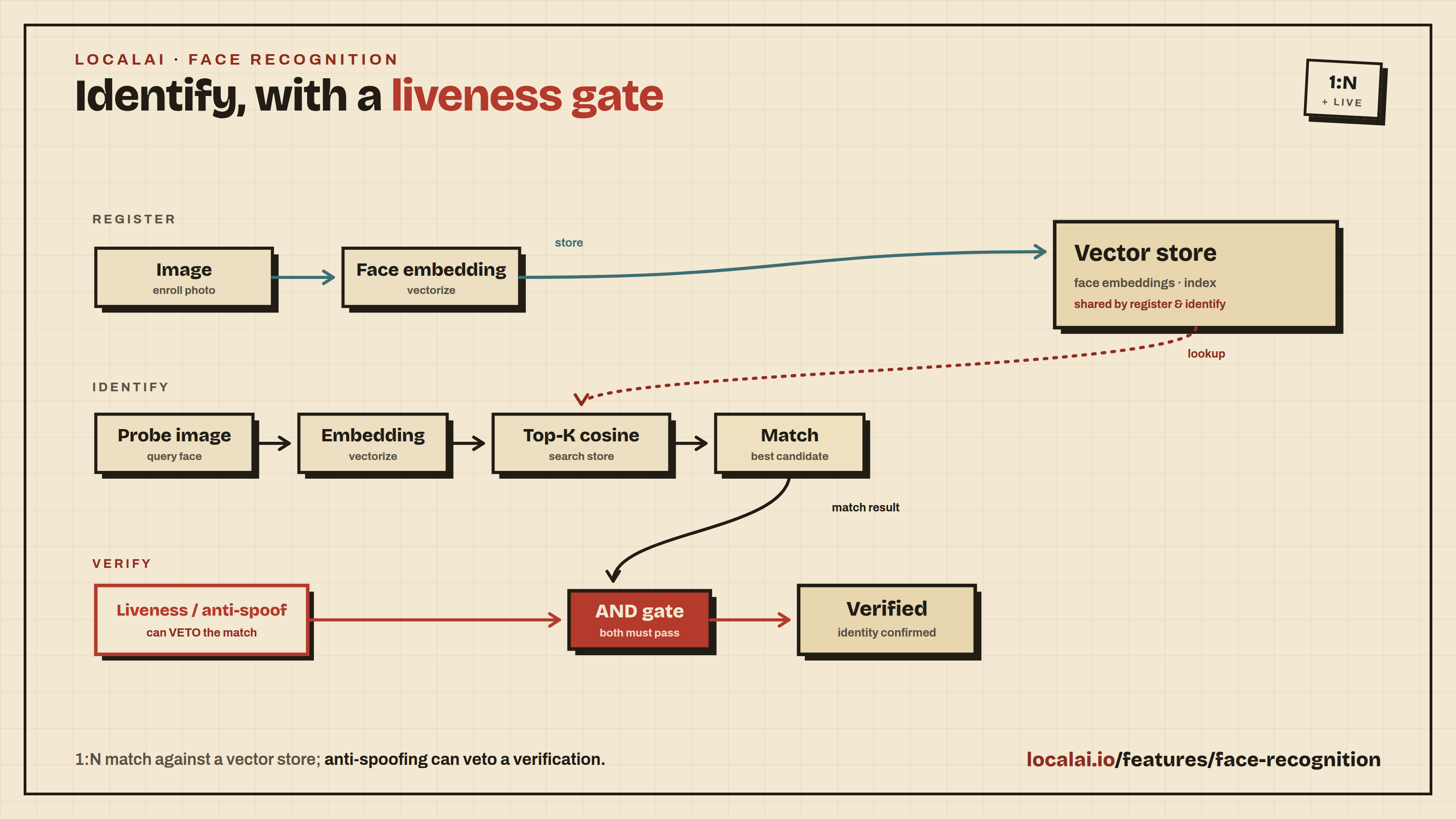
LocalAI supports face recognition: face verification (1:1), face identification (1:N) against a built-in vector store, face embedding, face detection, demographic analysis (age / gender), and antispoofing / liveness detection.
The same /v1/face/* HTTP API is served by two backends:
face-detect(recommended, default). A standalone C++/ggml engine (face-detect.cpp): no Python, no onnxruntime, no torch runtime. Each gallery entry is a single self-describing GGUF. This is the recommended option for new deployments.insightface(Python). The original ONNX Runtime backend. Still supported; see the Python backend below.
Both backends expose the identical wire format, so the API examples in
this page work with either - only the gallery entry name (the model
field) changes.
face-detect (ggml) backend
The face-detect backend reads the detector and recognizer architecture
(facedetect.arch) directly from the GGUF metadata, so installing a
gallery entry is all that is needed to select an engine. It drives the
Embeddings / Detect / FaceVerify / FaceAnalyze gRPC rpcs behind the
/v1/face/{embed,verify,analyze,detect,register,identify,forget}
endpoints.
Licensing - read this first
| Gallery entry | Detector + recognizer | Embedding dim | License |
|---|---|---|---|
face-detect-buffalo-l | SCRFD-10GF + ArcFace R50 + GenderAge | 512 | Non-commercial research only (upstream insightface weights) |
face-detect-buffalo-m | SCRFD-2.5GF + ArcFace R50 + GenderAge | 512 | Non-commercial research only |
face-detect-buffalo-s | SCRFD-500MF + MBF + GenderAge | 512 | Non-commercial research only |
face-detect-yunet-sface | YuNet + SFace (OpenCV Zoo) | 128 | Apache 2.0 - commercial-safe |
The insightface buffalo packs (buffalo_l / buffalo_m / buffalo_s) are
released by the upstream maintainers for non-commercial research use
only. Pick the face-detect-yunet-sface entry for production /
commercial deployments.
Quickstart
Install the commercial-safe entry (recommended for copy-paste):
Verify that two images depict the same person:
Detect faces and analyze demographics (buffalo entries populate age / gender; YuNet + SFace returns regions only):
The 1:N register / identify / forget workflow and the rest of the API
are identical to the API reference below - just pass a
face-detect-* model name. The per-engine verify thresholds are ~0.35
for the buffalo ArcFace/MBF recognizers and ~0.363 for SFace.
insightface (Python) backend
The insightface backend ships two interchangeable engines under
one image, each paired with a distinct gallery entry so users can pick
by license and accuracy needs.
Licensing - read this first
| Gallery entry | Detector + recognizer | Size | License |
|---|---|---|---|
insightface-buffalo-l | SCRFD-10GF + ArcFace R50 + GenderAge | ~326 MB | Non-commercial research only (upstream insightface weights) |
insightface-buffalo-s | SCRFD-500MF + MBF + GenderAge | ~159 MB | Non-commercial research only |
insightface-opencv | YuNet + SFace | ~40 MB | Apache 2.0 - commercial-safe |
The insightface Python library itself is MIT, but the pretrained model
packs (buffalo_l, buffalo_s, antelopev2) are released by the upstream
maintainers for non-commercial research use only. Pick the
insightface-opencv entry for production / commercial deployments.
Quickstart
Pull the commercial-safe backend (recommended for copy-paste):
Verify that two images depict the same person:
Response:
1:N identification workflow (register → identify → forget)
This is the primary “face recognition” flow. Under the hood it uses LocalAI’s built-in in-memory vector store - no external database to stand up.
Register known faces:
Identify an unknown probe:
Remove a person by ID:
Warning
Storage caveat. The default vector store is in-memory. All registered faces are lost when LocalAI restarts. Persistent storage (pgvector) is a tracked future enhancement - the face-recognition HTTP API is designed to swap the backing store without changing the wire format.
API reference
POST /v1/face/verify (1:1)
| field | type | description |
|---|---|---|
model | string | gallery entry name (e.g. insightface-buffalo-l) |
img1, img2 | string | URL, base64, or data-URI |
threshold | float, optional | cosine-distance cutoff; default depends on engine |
anti_spoofing | bool, optional | also run MiniFASNet liveness on each image - see Antispoofing |
Returns verified, distance, threshold, confidence, model,
img1_area, img2_area, and processing_time_ms. When
anti_spoofing is set, the response also carries per-image liveness
fields: img1_is_real, img1_antispoof_score, img2_is_real,
img2_antispoof_score. A failed liveness check on either image forces
verified=false regardless of similarity.
POST /v1/face/analyze
Returns demographic attributes for every detected face:
| field | type | description |
|---|---|---|
model | string | gallery entry |
img | string | URL / base64 / data-URI |
actions | string[] | subset of ["age","gender","emotion","race"]; empty = all supported |
Only insightface-buffalo-l / insightface-buffalo-s populate age and
gender (genderage head). insightface-opencv returns face regions with
empty attributes - SFace has no demographic classifier. Emotion and
race are always empty in the current release.
POST /v1/face/register (1:N enrollment)
| field | type | description |
|---|---|---|
model | string | face recognition model |
img | string | face to enroll |
name | string | human-readable label |
labels | map[string]string, optional | arbitrary metadata |
store | string, optional | vector store model; defaults to local-store |
Returns {id, name, registered_at}. The id is an opaque UUID used by
/v1/face/identify and /v1/face/forget.
POST /v1/face/identify (1:N recognition)
| field | type | description |
|---|---|---|
model | string | face recognition model |
img | string | probe image |
top_k | int, optional | max matches to return; default 5 |
threshold | float, optional | cosine-distance cutoff; default 0.35 (ArcFace) |
store | string, optional | vector store model; defaults to local-store |
Returns a list of matches sorted by ascending distance, each with id,
name, labels, distance, confidence, and match
(distance ≤ threshold).
POST /v1/face/forget
| field | type | description |
|---|---|---|
id | string | ID returned by /v1/face/register |
Returns 204 No Content on success, 404 Not Found if the ID is
unknown.
POST /v1/face/embed
Returns the L2-normalized face embedding vector for the detected face.
| field | type | description |
|---|---|---|
model | string | face model |
img | string | URL / base64 / data-URI |
Returns {embedding: float[], dim: int, model: string}. Dimension is
512 for the insightface ArcFace/MBF recognizers and 128 for OpenCV’s
SFace.
Note: the OpenAI-compatible
/v1/embeddingsendpoint is intentionally text-only by contract (inputis a string or list of strings of TEXT to embed) - passing an image data-URI there does nothing useful. Use/v1/face/embedfor image inputs.
Reused endpoint
POST /v1/detection- returns face bounding boxes withclass_name: "face"; works for both engines.
Antispoofing (liveness detection)
All gallery entries ship the Silent-Face-Anti-Spoofing
MiniFASNetV2 + MiniFASNetV1SE ensemble (Apache 2.0, ~4 MB total, CPU-only)
alongside the face recognition weights. Set anti_spoofing: true on
/v1/face/verify or /v1/face/analyze to run liveness on each detected
face. The two models look at different crop scales and their softmax
outputs are averaged before argmax - the upstream-recommended setup.
/v1/face/verify with liveness gating:
Response (fields added when anti_spoofing is enabled):
If either image fails liveness (is_real=false), verified is forced
to false - similarity alone is not enough.
/v1/face/analyze reports per-face is_real and antispoof_score
when the flag is set.
Fail-loud semantics. If anti_spoofing: true is sent against a
model installed without the MiniFASNet files (e.g. a custom entry that
only listed the face recognition weights), the request returns a gRPC
FAILED_PRECONDITION error - the endpoint will never silently return
is_real=false. Re-install the gallery entry or point the backend at a
model that bundles the MiniFASNet ONNX files.
Info
The MiniFASNet score is best at catching printed photos and screen replays. Deepfake videos and high-quality prosthetics are out of scope - liveness here is a low-cost first line of defence, not a guarantee. For higher assurance, combine with challenge-response (e.g. ask the user to turn their head).
Choosing an engine
| Need | Entry |
|---|---|
| Commercial product | insightface-opencv |
| Highest accuracy (research / demos) | insightface-buffalo-l |
| Edge / low-memory / research | insightface-buffalo-s |
The recommended default threshold for /v1/face/verify and
/v1/face/identify depends on the recognizer:
| Recognizer | Cosine-distance threshold |
|---|---|
ArcFace R50 (buffalo_l) | ~0.35 |
MBF (buffalo_s) | ~0.40 |
SFace (opencv) | ~0.50 |
Pass threshold explicitly when switching engines - the per-engine
default only fires when the field is omitted.
Related features
- Object Detection - generic bounding-box
detection;
/v1/detectionworks with the insightface backend too. - Embeddings - raw vector extraction; face embeddings live in the same endpoint under the hood.
- Stores - the generic vector store powering the 1:N recognition pipeline.