MITM proxy for Claude Code / Codex CLI
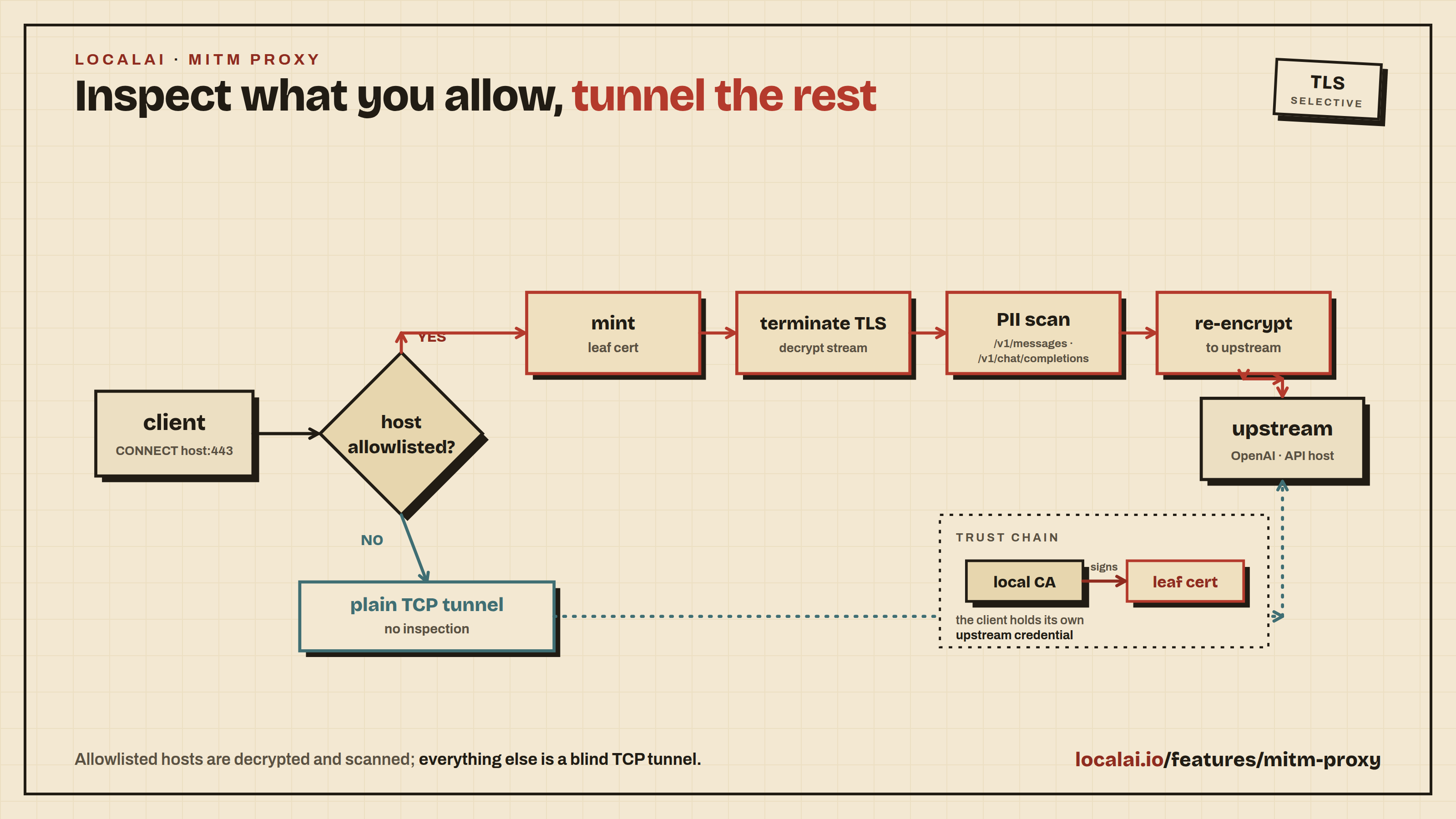
LocalAI can act as a local HTTPS proxy that redacts PII from your Claude
Code, OpenAI Codex CLI, or any HTTPS client without holding their API keys.
The proxy intercepts only the LLM API endpoints you allowlist (default:
api.anthropic.com, api.openai.com); everything else - OAuth, telemetry,
package fetches - passes through as a plain TCP tunnel.
Use this when:
- You want to use Claude Code with a Claude Pro/Max subscription but still apply the same PII redaction LocalAI applies to API-key traffic.
- You run Codex CLI on a corporate laptop and need an audit trail of prompts.
- You want LocalAI to enforce egress policies for AI traffic without becoming the API endpoint clients talk to.
The proxy is off by default. Operators opt in by setting --mitm-listen
and distributing the generated CA cert.
How it works
- The proxy generates a private CA on first start (persisted to disk).
- Clients set
HTTPS_PROXY=http://localai:portand add the CA to their trust store (e.g.NODE_EXTRA_CA_CERTSfor Node-based CLIs like Claude Code and Codex). - The CLI sends
CONNECT api.anthropic.com:443to the proxy. - For allowlisted hosts, the proxy mints a per-host leaf cert signed by
the CA, terminates TLS, parses the HTTP request, applies the global
PII redactor on
/v1/messagesor/v1/chat/completions, and forwards to the real upstream over its own TLS connection. - The streaming SSE response runs through the same
pii.StreamFilterthe cloud-proxy backend uses. - For non-allowlisted hosts, the proxy is a plain CONNECT tunnel - no TLS termination, no inspection, no CA trust required.
The CLI authenticates with its own subscription / API key as it normally would. LocalAI never holds the credential - it just observes and rewrites the request body.
Quick start
Start LocalAI with the MITM listener:
The first start generates a CA at <data-path>/mitm-ca/{ca.crt,ca.key}.
Restarting reloads the same CA so clients keep trusting it.
Download the public CA cert:
Configure Claude Code to use the proxy and trust the cert:
Now any claude chat session that touches api.anthropic.com/v1/messages
gets its prompts and tool inputs scanned by LocalAI’s PII filter, and any
PII the model emits in its streaming response is masked before reaching
your terminal. Events appear in the LocalAI middleware admin page under
Filtering → Recent events.
The same works for Codex CLI - set HTTPS_PROXY and NODE_EXTRA_CA_CERTS
and run codex.
Configuration
The proxy is enabled with two startup settings:
| Flag / env | Default | Purpose |
|---|---|---|
--mitm-listen / LOCALAI_MITM_LISTEN | empty (disabled) | Address to bind the proxy listener on |
--mitm-ca-dir / LOCALAI_MITM_CA_DIR | <data-path>/mitm-ca | Where to persist the CA cert + key |
There is no global intercept-hosts flag. The hosts whose TLS is terminated
and scanned are declared per model, in the model YAML mitm.hosts:
block. Each model that names one or more hosts owns those hosts; everything
not listed by any model tunnels through untouched. A cloud-proxy model that
should intercept Anthropic traffic looks like:
Hostnames are case-insensitive. Add custom upstreams (e.g. an
OpenAI-compatible third-party provider) by adding their hostname to a
model’s mitm.hosts: list and ensuring their endpoint paths match
/v1/chat/completions or /v1/messages. You can create these models from
the Add Model UI.
What gets redacted
The MITM proxy runs the same PII detection as the regular request
middleware. Detection is NER-based (a token-classification detector
model), not a fixed regex list: the older pattern tier has been removed.
See /features/middleware/ for how detector models, entity
groups, and the mask / block actions are configured, and for the
instance-wide default detector.
A block action returns HTTP 400 with error.type=pii_blocked to the
client. The CLI sees the rejection and shows it as a request error.
Events are persisted via the same pii.EventStore the rest of LocalAI
uses, so the /api/pii/events endpoint and the middleware admin page
include MITM events alongside direct-API events.
Security notes
- The CA private key is the master credential. Anyone with read
access to
<data-path>/mitm-ca/ca.keycan forge TLS for any host the proxy could intercept. The file is mode 0600; keep it that way. - The proxy listener accepts plaintext HTTP
CONNECTrequests - bind it to localhost (--mitm-listen 127.0.0.1:8443) unless you’ve added auth in front of the listener. There is no built-in API-key check on this port. - The MITM CA is separate from any TLS cert LocalAI’s main HTTP API uses. Installing the MITM CA grants trust only for traffic that flows through this proxy.
- The proxy does not pin upstream certificates; it trusts the system certificate store. If your machine’s trust store is compromised, the proxy is too.
- TLS termination negotiates HTTP/2 by default (ALPN
h2) and falls back to HTTP/1.1 for clients that don’t speak h2. Modern CLIs (Claude Code, Codex) and the Anthropic / OpenAI APIs all use h2.
Limitations
- Only
/v1/messagesand/v1/chat/completionsget redacted. Other paths on the same host (OAuth, model listing) are forwarded verbatim. - No request-shape translation. The proxy assumes the request body matches the host’s wire format; cross-shape forwarding is the cloud proxy backend’s job, not the MITM’s.
- No CA rotation in the MVP. To rotate, delete
ca.keyandca.crtand re-distribute the new cert to every client. - Cert pinning kills MITM. Neither Claude Code nor Codex CLI pins certificates today, but a future SDK update could. If a CLI starts refusing the proxied handshake, that’s the signal.
Comparison with the cloud-proxy backend
LocalAI ships two cloud-related proxy modes; pick by who holds the credential:
Cloud-proxy backend (backend: proxy-*) | MITM proxy (--mitm-listen) | |
|---|---|---|
| Client config | localai:8080 as API endpoint | localai:8443 as HTTPS_PROXY |
| Holds API key | LocalAI | Client (CLI’s own auth) |
| Works with subscription auth | No | Yes (CLI uses its own login) |
| Request rewriting | Yes (handler controls it) | Yes (selective per host+path) |
| CA cert distribution | Not needed | Required on every client |
| Routes through LocalAI’s auth/usage tracking | Yes | Yes (per-correlation-id events) |
For shared deployments where LocalAI owns the API key and clients are unsophisticated (curl, simple webapps), use the cloud-proxy backend. For “give my Claude Code a privacy filter” use cases, use the MITM proxy.