This section collects the operator-facing concerns for running LocalAI in production: request middleware, cloud and MITM proxies, and backend monitoring. These pages are about running and governing a LocalAI instance rather than about a specific inference feature.
Backend Monitor - monitor, pre-load, and shut down running model backends.
Subsections of Operations
Backend Monitor
LocalAI provides endpoints to monitor and manage running backends. The /backend/monitor endpoint reports the status and resource usage of loaded models, /backend/load pre-loads a model into memory, and /backend/shutdown allows stopping a model’s backend process.
All three are admin-only.
Monitor API
Method:GET
Endpoints:/backend/monitor, /v1/backend/monitor
Request
The model to monitor is passed as a query parameter:
Parameter
Type
Required
Location
Description
model
string
Yes
query
Name of the model to monitor
For backwards compatibility, a JSON body with the same field is still accepted when the model query parameter is not set, but new clients should use the query parameter.
Pre-loads a model into memory ahead of its first request, so that request pays no cold-start load cost. It is the inverse of the Shutdown API and works for any model, not just realtime pipelines.
Method:POST
Endpoints:/backend/load, /v1/backend/load
Request
Parameter
Type
Required
Description
model
string
Yes
Name of the model to load
Behavior
For a regular model, its own backend is loaded.
For a realtime pipeline model (a config with a pipeline: block), every configured sub-model (VAD, transcription, LLM, TTS, sound_detection, voice_recognition) is loaded concurrently instead of the pipeline stub, which has no backend of its own.
The call blocks until loading finishes and reports which model names became resident, so partial failures are visible.
LocalAI ships a request-middleware layer that sits between the HTTP API and
the backend dispatcher. Two subsystems share that layer because they share
the same lifecycle hook: PII filtering scans the request body before it
reaches a backend, and the intelligent router rewrites input.Model so
a single client-facing model name fans out across multiple downstream
targets.
Both are inspected and configured from the same admin page
(/app/middleware), backed by the same REST surface (/api/middleware/*,
/api/pii/*, /api/router/*) and the same MCP tools.
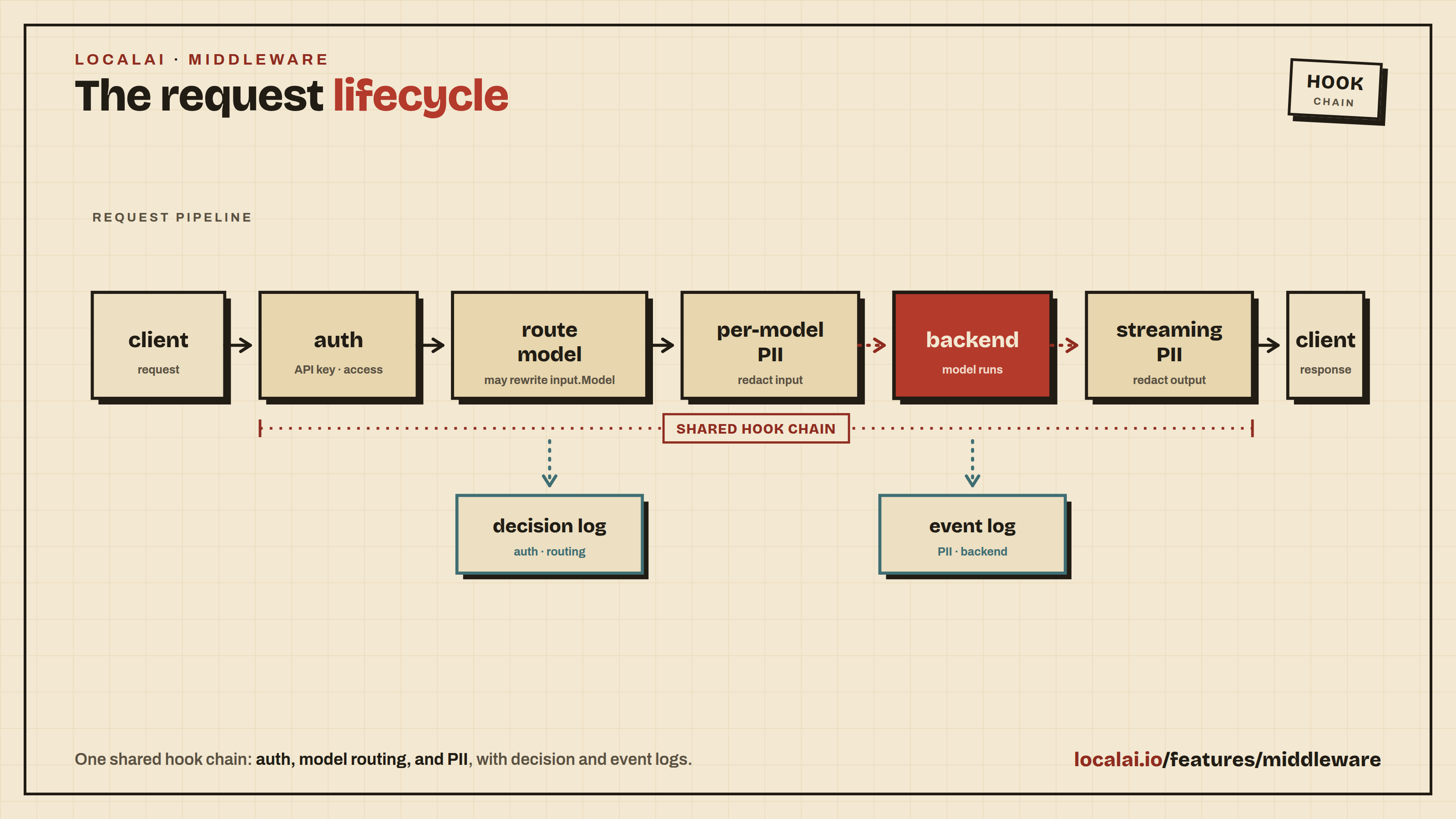
The router runs first (it picks the target model so per-model PII has
something to gate on), per-model PII runs next (gated by the resolved
config), and the backend executes. Filtering is request-side only -
the request body is scanned and rewritten before forwarding; the response
is not touched (NER over a streamed response is left as a follow-up). Each
subsystem writes to its own admin-visible log: /api/router/decisions for
routing, /api/pii/events for redaction and block actions.
PII filtering
PII redaction is NER-based and runs request-side (input). It is
off by default, flipping to on for any cloud-proxy backend
because that traffic crosses the network to a third-party provider. Pick a
default detector so those models are actually
scanned. Explicit pii.enabled in a model’s YAML always wins over the
backend default.
Filtering runs on every text-accepting endpoint that has an adapter wired:
/v1/chat/completions and /v1/messages (chat), /v1/completions,
/v1/embeddings, /v1/edits, and the Ollama /api/chat, /api/generate
and /api/embed endpoints, plus the MITM proxy
request body. Image, audio (TTS/STT), video, rerank, and the realtime
WebSocket are not filtered yet (different prompt-PII semantics; realtime is
not HTTP middleware).
A request’s messages are scanned as one document (joined in order), so
the NER detector keeps conversational context: whether 4421 is a PIN or
jdoe_42 is a username is usually decided by the question asked in the
previous message, and a bidirectional encoder only sees that context when
the messages share a forward pass. Detected spans are mapped back to the
individual message they fall in, so redaction still rewrites each message
field in place and events carry message-local offsets.
The earlier regex pattern tier (pii.patterns, the built-in pattern
catalogue, --pii-config, the /api/pii/patterns|test|decide endpoints)
and response/streaming-side redaction have been removed. Detection is
now driven entirely by token-classification (NER) models. Legacy keys
no-op with a startup warning.
Detector models
A detector is a token_classify model (e.g. an openai-privacy-filter
GGUF) that carries the detection policy in a top-level pii_detection:
block - defined once, on the model itself:
name: privacy-filter-multilingualbackend: privacy-filterembeddings: true# TOKEN_CLS poolingknown_usecases:
- token_classifypii_detection:
min_score: 0.5# drop detections below this confidencedefault_action: mask # applied to any detected group with no entryentity_actions: # which PII to block vs mask vs allow-logPASSWORD: blockCREDITCARD: blockEMAIL: mask
mask rewrites the matched span to [REDACTED:ner:<GROUP>] in the request
body before forwarding. block returns HTTP 400 (error.type=pii_blocked)
without forwarding. allow detects and logs (a PIIEvent is still recorded)
but leaves the text unchanged. The entity-group names are whatever the model
emits (the privacy-filter family uses uppercase names like EMAIL,
PASSWORD, CREDITCARD).
Pattern detector tier
NER is the wrong tool for high-entropy, highly-regular secrets - API keys,
tokens, private-key blocks. A trained NER model has no “API key” class, so it
fragments a key into the nearest categories it does know and can leave the
secret part exposed. Those secrets are exactly what a regex catches cheaply.
A pattern detector is a detector model (backend: pattern) that matches
secrets with a restricted regex subset compiled to Go’s RE2 engine -
linear-time, no backtracking, no ReDoS. It runs entirely in-process: no model
download, no backend, zero VRAM. Install the gallery’s secret-filter for a
ready-made set, or define your own:
name: secret-filterbackend: patternknown_usecases: [token_classify] # so it appears in the detector pickerpii_detection:
default_action: block # a leaked credential shouldn't leavebuiltins: # built-in catalogue (enable by name) - anthropic_api_key - openai_api_key - github_token - aws_access_key - private_key_blockpatterns: # operator-defined, restricted subset - name: INTERNAL_TOKENmatch: "tok-[A-Za-z0-9]{32,64}"action: block # optional per-pattern overridemin_len: 36# optional length floor
A match is reported under its group (built-in group name, or the pattern
name), so entity_actions / default_action apply exactly as for NER.
The restricted grammar (validated at load - an invalid pattern is rejected,
not silently ignored):
Allowed: literals, character classes […] and \w \d \s, alternation,
anchors ^ $ \b, and quantifiers ? * + {m,n}.
Rejected: . (any-char), capturing groups, and {n,m} bounds over 4096.
Required anchor: every pattern must contain a fixed literal run of at
least 3 characters (e.g. sk-ant-, ghp_, AKIA). This admits real key
shapes but rejects open-ended ones - an email or a bare \w+ has no such
anchor and belongs to the NER tier.
Use both tiers together: reference an NER detector and a pattern detector in a
model’s pii.detectors (or as instance defaults); their hits union, and a
block from either rejects the request.
Consuming models
Any model opts in by enabling PII and referencing one or more detectors -
no per-consumer policy:
name: claude-strictbackend: cloud-proxyproxy:
mode: passthroughprovider: anthropicupstream_url: https://api.anthropic.com/v1/messagesapi_key_env: ANTHROPIC_API_KEYpii:
enabled: true# default-on for cloud-proxy; explicit for auditdetectors:
- privacy-filter-multilingual
Multiple detectors union their detections; overlapping spans resolve to
the strongest action (block > mask > allow). A configured detector
that can’t be loaded fails the request closed (HTTP 503,
error.type=pii_ner_unavailable) rather than silently skipping the check.
The same NER path runs on the MITM proxy
request body for intercepted hosts. Response/output redaction is out of
scope for now.
Instance-wide default detector
The Detector models table on the Middleware → Filtering page lists every
token_classify detector model (neural NER models and in-process pattern
matchers alike) and exposes a per-row Default toggle. Toggling a detector
on adds it to the instance-wide default detector set - one or more models
applied to any PII-enabled model that names none of its own pii.detectors.
It is persisted through POST /api/settings and read live, so a change takes
effect on the next request without a restart. A default that names a model no
longer loaded still appears (marked not loaded) so it can be toggled off.
The default set can also be supplied out-of-band with the
LOCALAI_PII_DEFAULT_DETECTORS environment variable (comma-separated model
names, e.g. privacy-filter-nemotron,secret-filter). When set it takes
precedence over the value persisted via the UI (env > file), which is the
right behaviour for immutable container deployments that pin filtering policy
at boot rather than via the admin UI.
This is what makes cloud-proxy / MITM redaction work out of the box: those
backends default to PII-enabled but ship no detector list, so without a
default detector the filter runs with nothing to scan. Set one here and
cloud-proxy traffic is scanned with no per-model config.
Resolution precedence (the single decision point is ResolvePIIPolicy,
shared by the chat middleware and the MITM listener so both agree):
An explicit pii.enabled on the model wins - true or false.
Otherwise PII is on if the backend defaults it on (cloud-proxy).
Detectors are the model’s own pii.detectors; if it lists none, the
instance-wide default detector(s) are used.
A model that resolves enabled but ends up with no detector at all (a
cloud-proxy model with no model detectors and no instance default) scans
nothing - set a default detector to close that gap.
Admin page
The /app/middleware page (admin role only) has four tabs - Filtering,
Routing, MITM Proxy (see the MITM doc),
and Events. The Filtering tab has a Detector models table (every
token_classify filter model, with the per-row Default toggle above and an
edit link to each detector’s config, plus an Add detector model button) and
a per-model table listing only the models PII can actually apply to - chat /
completion / embeddings / edit consumers and cloud-proxy models, not
VAD/STT/image models or the detector models themselves. Each row reports the
effectiveenabled state as an inline toggle - flipping it writes an
explicit pii.enabled to that model’s YAML (a server-side deep-merge that
preserves pii.detectors and every other field), so a cloud-proxy model shown
on by backend default can be turned off, and vice-versa - plus the
resolved detector(s) - with a (default) marker when they come from the
instance-wide default rather than the model’s YAML - why it is on (YAML /
backend default), and the recent event count. Detection policy
(entity→action, min score) is still edited on each detector model’s config
(Models → edit → PII), not globally.
Analyze / redact API
The same detection pipeline is also exposed as a standalone service, so a
client can scan or sanitise a string without routing a full chat request
through it (the inline path above). Two endpoints, both requiring a normal API
key (the pii_filter feature - not admin):
POST /api/pii/analyze - detect only. Returns the matched entity spans
(entity_type, sourcener|pattern, start/end, score, action)
and a blocked flag, without modifying the text.
POST /api/pii/redact - apply the configured policy. Returns redacted_text
(with masked spans replaced by [REDACTED:<id>]) and masked; when a block
action fires it returns 400 with type: pii_blocked and the offending
entities - never a redacted body.
Both take the same request: text plus a detector selection - either explicit
detector model names in detectors, or a consuming model whose effective
policy is used: the model’s own pii.detectors, else the
instance-wide default detectors, exactly as
the inline filter resolves them. A model with PII disabled - or enabled but
with no detector anywhere - is a 400: the inline filter would scan nothing
for it, and the API says so rather than implying a clean scan. The detection
policy lives on the detector models exactly as for the inline filter. The raw
matched value is never returned (an admin may pass reveal: true to include
the audit hash_prefix).
text is scanned as a single document. To reproduce the inline filter’s
conversation-context behaviour for multi-message content, join the messages
with blank lines into one text - NER detection quality depends on that
context (a bare 4421 is nothing; after “what are the last four digits of
your card?” it is a PIN).
# Redact with an explicit pattern/NER detectorcurl -sX POST http://localhost:8080/api/pii/redact \
-H 'Authorization: Bearer $API_KEY' -H 'Content-Type: application/json'\
-d '{"text":"reach me at jane@acme.io","detectors":["my-ner-model"]}'# => {"redacted_text":"reach me at [REDACTED:ner:EMAIL]","masked":true,...}# Analyze using a consuming model's configured detectorscurl -sX POST http://localhost:8080/api/pii/analyze \
-H 'Authorization: Bearer $API_KEY' -H 'Content-Type: application/json'\
-d '{"text":"sk-ant-api03-…","model":"gpt-4"}'# => {"entities":[{"entity_type":"ANTHROPIC_KEY","source":"pattern",...,"action":"block"}],"blocked":true}
Calls are audited in the same event log, tagged with an origin of
pii_analyze / pii_redact (the inline filter records middleware, the MITM
proxy records proxy), so GET /api/pii/events?origin=pii_redact shows just
the redact-API rows.
REST surface
Method
Path
Auth
Purpose
POST
/api/pii/analyze
api key (pii_filter)
Detect PII in a string; returns entity spans, no mutation.
POST
/api/pii/redact
api key (pii_filter)
Redact a string per policy; returns redacted_text or 400 pii_blocked.
Aggregated dashboard data: per-model PII state + detectors + router status + MITM status + admission status. One round-trip for the UI.
MCP tools
The same surface is mirrored through the LocalAI Assistant MCP server:
Tool
Read/Write
Purpose
get_pii_events
read
Recent redaction / block events with optional filters.
get_middleware_status
read
Aggregator - the same payload as GET /api/middleware/status.
Detection policy is part of a detector model’s config, so it is managed
through the model-config tools (edit_model_config), not a dedicated PII
tool.
Intelligent routing
A router model is a model whose YAML carries a router: block. When
a client addresses it ("model": "smart-router"), the middleware
classifies the prompt, picks a downstream candidate model, rewrites
input.Model to the candidate, and the standard model-resolution path
runs against that resolved target. ACL checks, disabled-state, and
per-model PII all apply to the resolved model - the router does
model selection only.
Depth-1 invariant
Candidates must not themselves be router models. A
smart-router → claude-strict → cloud-proxy chain is fine
(claude-strict is a regular cloud-proxy model). A
smart-router → other-router → real-model chain is rejected at runtime
by the middleware (the dispatcher returns HTTP 500 with a
depth-1 invariant error). This keeps the dispatch graph acyclic and
predictable.
Fallback
If no candidate’s label set covers the active label set from the classifier,
or the classifier errors out, the router uses cfg.Router.Fallback.
An empty fallback causes the dispatch to fail with HTTP 500 rather
than silently routing somewhere unintended - fail-fast, not
silent-bypass.
Available classifiers
LocalAI ships two classifier implementations. Pick one with classifier:
in the router YAML:
Classifier
When to use
Underlying primitive
score (default)
Small classifier-tuned LM (Arch-Router-style). Best when label vocabulary is well-covered by next-token continuation.
Score gRPC primitive (llama-cpp, vLLM).
colbert
When label descriptions are abstract or short and a next-token classifier produces flat distributions. Robust on long-form policy descriptions.
rerankers backend in ColBERT mode (e.g. bge-m3-colbert from the gallery).
Both classifiers share the same YAML shape: classifier_model,
policies, candidates, fallback, activation_threshold,
classifier_cache_size, and the optional embedding_cache block.
The Score classifier
The score classifier works like this:
Build a Qwen/ChatML system prompt that lists every policy label with
its description and primes the model to emit a label as the assistant
turn.
Ask the classifier model to score every policy label as the
first-token(s) continuation. This uses the Score gRPC primitive
(backend.proto::Score), which returns per-candidate log-probabilities
length-normalized so candidates of unequal token length stay
comparable.
Softmax the length-normalized log-probabilities into a probability
distribution over labels.
Threshold the distribution: every label whose probability passes
activation_threshold joins the active label set.
Pick the FIRST candidate whose Labels is a superset of the active
set. Admins order candidates smallest → largest so a single-label
query routes to the smallest capable model, while a query that
activates multiple labels falls to a candidate that covers them all.
This is the Arch-Router approach extended for multi-label. The
distribution carries more signal than the argmax - reading off the
spread lets one prompt activate multiple policies and route to a model
capable of all of them.
Recommended classifier model
Arch-Router-1.5B is
the canonical choice. It’s a Qwen-2.5-1.5B-Instruct base trained
specifically on routing-policy continuation, so the ChatML system-prompt
label-continuation pattern produces well-separated label probabilities
without prompt tuning. The Q4_K_M GGUF runs on CPU, GPU, and Intel SYCL.
The classifier model must support the Score gRPC primitive (today: the
llama-cpp and vLLM backends) and use the ChatML chat template. Any small
ChatML instruct model works under those constraints, but expect flatter
probability distributions which translate to a higher
activation_threshold to keep noise out of the active label set.
On llama-cpp, scoring rides the server’s task queue alongside
generation and embeddings, so the classifier may share a model config
with chat/completion/embeddings - a dedicated scorer model is no
longer required. Repeated calls with the same prompt also reuse the
prompt’s KV cache across candidates.
The Colbert classifier
The colbert classifier reranks each policy description against the
prompt via the rerankers backend and activates the labels whose
relevance scores clear activation_threshold (default 0.5 for
reranker-style scores in [0, 1]).
router:
classifier: colbertclassifier_model: bge-m3-colbert # gallery entry; loads BAAI/bge-m3 in ColBERT modeactivation_threshold: 0.5policies:
- label: code-generationdescription: writing, debugging, reading, or explaining code - label: casual-chatdescription: small talk, greetings, jokescandidates: [...]
The reranker scores the description (natural English) rather than
asking a small LM to score the label as a next-token continuation,
so it tends to be more robust when policy labels are abstract slugs
(compliance-review, tier-2-support). The trade-off is one
reranker round-trip per request - bge-m3 in ColBERT mode is fast
enough on GPU that this is comparable to the Score path for most
workloads. The embedding_cache block applies identically.
The reranker model’s type: (in the model YAML) selects which
underlying scoring head loads - colbert for late-interaction MaxSim,
cross-encoder for cross-attention scoring. The classifier itself is
indifferent; pick the head that fits your latency / quality budget.
YAML reference
name: smart-routerknown_usecases:
- chatrouter:
# `score` (Arch-Router-style next-token scoring) or `colbert`# (rerank policy descriptions). See "Available classifiers" above.classifier: score# A model loaded by LocalAI that supports the Score gRPC primitive# (llama-cpp and vLLM ship implementations). Arch-Router-1.5B is the# canonical choice.classifier_model: arch-router-1.5b# Bounded LRU keyed on (case-folded, whitespace-trimmed) prompt - prompts# repeat in agent loops; the cache amortises the classifier round-trip# across them. 0 here means "use the default" (1024); the cache cannot be# disabled from YAML today.classifier_cache_size: 256# Softmax probability floor a label must clear to join the active label set.# 0 = use the package default (0.15). 0.40 is a better empirical# starting point on Arch-Router-1.5B - see the tuning note below.activation_threshold: 0.40# Used when no candidate covers the active label set, or the classifier# itself errors. Empty here = fail-fast with HTTP 500.fallback: qwen3-0.6b# The label vocabulary. Descriptions are fed verbatim into the# classifier's system prompt - short, action-oriented sentences work# best ("writing or debugging code", "small talk").policies:
- label: code-generationdescription: writing, debugging, reading, or explaining code in any programming language - label: casual-chatdescription: small talk, greetings, jokes, or general conversation with no specific task - label: math-reasoningdescription: arithmetic, equations, percentage calculations, or step-by-step word problems# Routing table - order matters (smallest → largest). See "Score# classifier" above for the matching rule.candidates:
- model: qwen3-0.6blabels: [casual-chat] - model: qwen_qwen3.5-2blabels: [code-generation, casual-chat, math-reasoning]
Tuning activation_threshold
The threshold is the single knob you’ll want to tune per
(classifier-model, policy-set) pair. On Arch-Router-1.5B with the
three-policy setup above, sweeping the threshold over a hand-labeled
30-prompt corpus produced:
Threshold
Label-set accuracy
End-to-end routing accuracy
0.15 (package default)
30%
73%
0.30
57%
87%
0.40
60%
90%
0.45
67%
97%
0.50
67%
97%
The classifier’s argmax matches the dominant label 93% of the time on
this corpus - what the threshold controls is how much secondary-label
noise leaks into the active label set. Low thresholds push single-label
queries to multi-label-capable (larger) candidates unnecessarily; 0.40
keeps the dominant label dominant without losing genuine compound
activations.
Re-tune per (classifier-model, policy-set) pair. The /api/score
endpoint (see below) is the convenient probe - it returns the raw
length-normalized log-probabilities so you can sweep thresholds offline
without driving real chat completions.
Embedding cache (L2)
Classification is the most expensive thing the middleware does. The
score classifier already memo-caches verbatim repeats (case- and
whitespace-folded prompt → decision); the embedding cache is the
L2 tier that catches semantically similar prompts - “How do I exit
vim?” and “i need to quit vim” can share a decision instead of running
the classifier twice.
Pairs naturally with a larger / slower classifier model: the steady-state
cost on cache hits collapses to one embedding round-trip plus a KNN
search, both well under 100ms with nomic-embed-text-v1.5 + local-store.
Configuration
Add an embedding_cache: block to a router model:
router:
classifier: scoreclassifier_model: arch-router-1.5bpolicies: [...]candidates: [...]embedding_cache:
embedding_model: nomic-embed-text-v1.5 # any loaded embedding modelsimilarity_threshold: 0.80# cosine sim floor for a hit (default 0.80)confidence_threshold: 0.60# min top-label prob to cache a decision (default 0.60)# store_name: router-cache-smart-router # optional override; defaults to "router-cache-<router>"
Omit the block entirely to disable. The cache adds two new failure modes
(embedder unavailable, store unavailable) - both fall through to the
inner classifier so routing keeps working.
How it works
For each request:
Embed the probe prompt via the configured embedding_model.
KNN top-1 against the per-router local-store collection.
If similarity ≥ similarity_threshold, return the cached decision
(Cached=true, CacheSimilarity=<sim> in the decision log).
Miss → run the inner classifier. If decision.score >= confidence_threshold,
insert (embedding, decision) into the store. Low-confidence
decisions are deliberately skipped so they can’t poison future
paraphrases.
The local-store collection is named router-cache-<router-model-name> by
default - each router gets its own collection so two routers can’t
cross-contaminate. Collections persist on disk (local-store is the
canonical persistent vector backend), so the cache survives restarts.
Tuning notes
Similarity threshold: 0.80 is the package default - re-tune
per (embedding model, corpus). The histogram on the Routing tab
shows where the cosine distribution actually sits; pick a
threshold above the cross-intent cluster and below the paraphrase
cluster.
Confidence threshold: 0.60 corresponds roughly to “the
classifier is committed to a top label.” Don’t lower this - caching
unsure decisions propagates the uncertainty.
Cache flush: invalidates automatically when the router YAML
changes (the classifier cache is fingerprinted by yaml.Marshal),
but the underlying local-store collection still holds the old
payloads. Manual flush via local-store admin or by renaming
store_name if you need a hard reset.
Latency budget: an embedding round-trip (typically 30-80ms for
small embedding models) plus KNN search (~5ms) is added to every
miss on top of the classifier latency. Cache hits skip the
classifier entirely. Break-even is around 7-10% hit rate; agent
loops with repeated phrasing easily exceed this.
Admin page
The /app/middleware page has a Routing tab listing every router
model’s classifier, policies, candidates, and fallback. The Events
tab shows the decision log - one row per classified request with
correlation ID, requested model, served model, classifier name, active
labels, top-label score, and latency.
Routing decisions are stored in an in-process ring buffer (default
capacity 5,000). The decision log is for audit and tuning - the
canonical usage log lives in /api/usage and correlates by request ID.
REST surface
Method
Path
Auth
Purpose
GET
/api/router/status
any
Router configuration: each router model’s classifier, policies, candidates.
GET
/api/router/decisions
admin
Decision log with optional filters (correlation_id, user_id, router_model, limit).
POST
/api/score
admin
Direct access to the Score gRPC primitive - useful for offline threshold tuning. Body: {"model": "<classifier-model>", "prompt": "<chatml-prompt>", "candidates": ["label-a", ...], "length_normalize": true}. The llama-cpp and vLLM backends implement Score; other backends return UNIMPLEMENTED.
MCP tools
Tool
Read/Write
Purpose
get_router_decisions
read
Recent decision log with optional filters.
get_middleware_status
read
Includes the router section listing configured router models.
Mutating routing config - adding a candidate, changing the classifier
model - is YAML-only today; reload with POST /models/reload to pick
up edits without restarting.
Operational notes
Reload after YAML edits. The router configs are loaded at startup
and cached. POST /models/reload re-reads from disk; the next request
rebuilds the classifier from the new config (the classifier cache is
fingerprinted by yaml.Marshal(RouterConfig) so it invalidates
automatically).
Classifier latency on Arch-Router-1.5B Q4_K_M is ~500ms steady
for 3 policies on Intel SYCL. The score primitive re-decodes the full
prompt for every candidate today (the KV cache is cleared between
candidates); the prompt-KV-sharing optimization is on the perf TODO
list in backend/cpp/llama-cpp/grpc-server.cpp::Score. Until then,
classifier_cache_size is the highest-leverage knob for repeat-query
workloads (agent loops).
Decision log size: 5,000-entry ring buffer per process. The
log is in-process and not persisted - pair with the usage log for
long-horizon audit.
Related features
Cloud passthrough proxy - combine
the router with proxy-* backends to send simple prompts to local
models and complex ones to cloud providers.
MITM proxy - apply the same PII
filter to Claude Code, Codex CLI, and any HTTPS client without
LocalAI holding their API keys.
Authentication - admin role is
required for mutating endpoints and the /app/middleware page; in
no-auth single-user mode the synthetic local user has admin role
automatically.
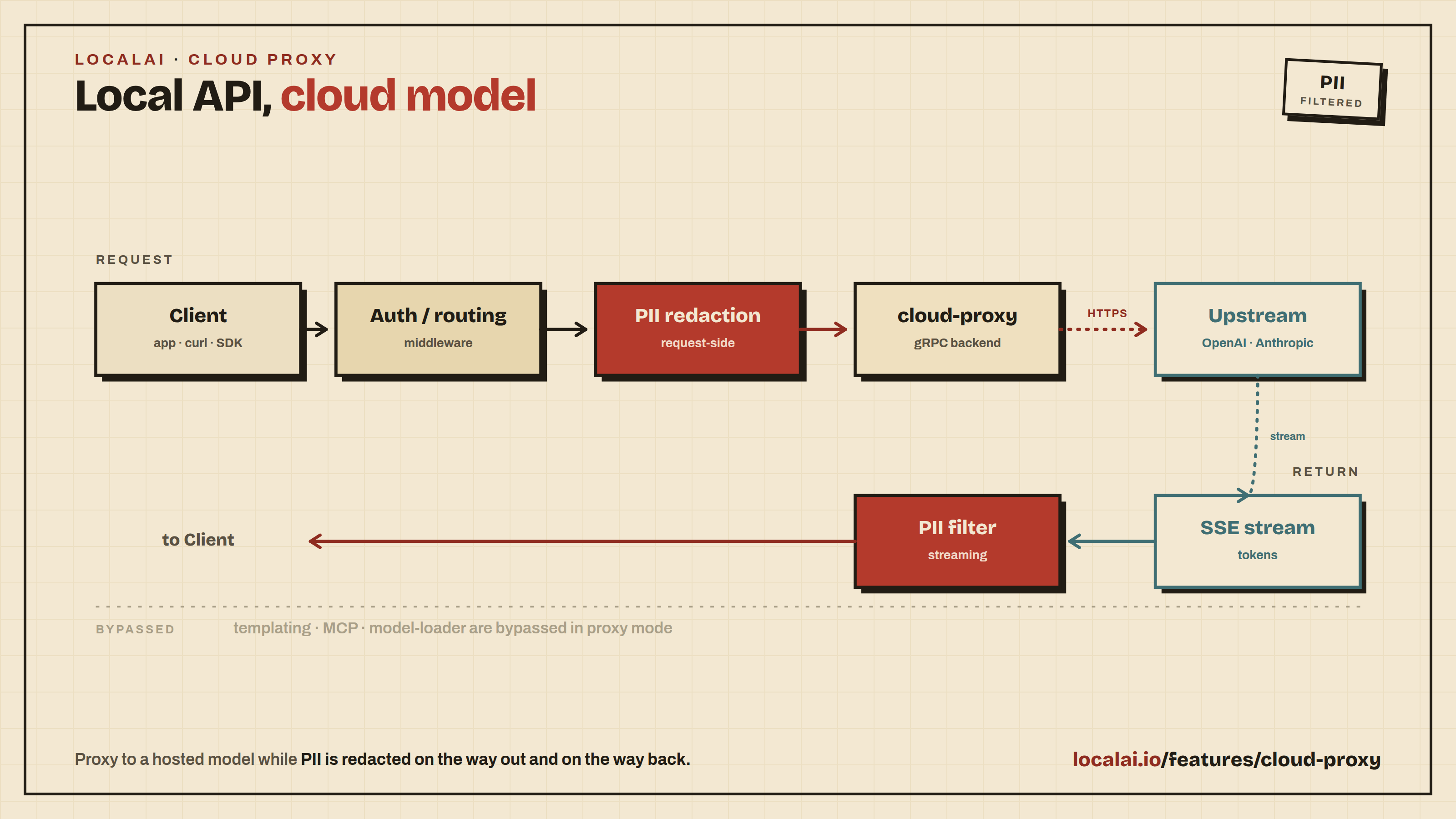
LocalAI can forward chat-completion and Anthropic Messages requests to an
external provider instead of running them through the local gRPC backend
pipeline. Configure a model with backend: cloud-proxy and a proxy.upstream_url,
and LocalAI bypasses templating, MCP injection, and the local model loader
entirely - the upstream sees the body the client sent (with only the top-level
model field optionally rewritten).
The streaming PII filter still runs over the upstream’s SSE stream, so cloud
egress remains subject to the same redaction rules a local model would apply.
When to use this
Mix local and cloud models in the same LocalAI instance - clients hit one
endpoint, LocalAI dispatches per model.
Apply LocalAI’s auth, usage tracking, and PII redaction to cloud traffic
before the body leaves the network.
Use the intelligent router to send small or simple prompts to a local model
and complex ones to Claude or GPT-4o.
How it works
Request hits LocalAI on /v1/chat/completions (OpenAI-shaped) or
/v1/messages (Anthropic-shaped).
The standard auth and routing middleware runs.
Per-model PII redaction runs request-side as it would for any model.
The handler detects the cloud-proxy backend in passthrough mode and
loads the cloud-proxy gRPC backend, which owns the outbound HTTP.
The backend POSTs the body to proxy.upstream_url with provider-aware
authentication, then streams the SSE response back to core.
The streaming PII filter rewrites per-token text in flight; the upstream’s
event names and metadata pass through unchanged.
Passthrough mode is wire-format-faithful - it does not translate request
shapes between providers. A client posting an OpenAI-shaped body to an
Anthropic upstream will get a confused upstream. Use the matching wire format,
or switch to translate mode (below).
Configuration
The cloud-proxy backend has one knob - the provider it should authenticate
against - and two modes:
proxy.mode
What it does
When to use
passthrough (default)
Forwards the request body verbatim to upstream_url. Client must speak the upstream’s wire format.
Same wire format on both ends.
translate
Backend converts internal proto to the upstream’s wire format. Client can speak OpenAI-shaped requests to an Anthropic upstream, etc.
Cross-format adaptation.
proxy.provider selects the auth scheme and (in translate mode) the wire
format. Supported values: openai, anthropic.
API keys are loaded from either an environment variable (api_key_env) or a
file (api_key_file). The key never appears in the config file or the admin
UI; pick whichever fits your secret-management setup.
OpenAI passthrough
name: gpt-4o-proxybackend: cloud-proxy# When set, replaces the client's "model" field before forwarding.# Useful when the LocalAI alias differs from the upstream's canonical name.proxy:
mode: passthroughprovider: openaiupstream_url: https://api.openai.com/v1/chat/completionsapi_key_env: OPENAI_API_KEYupstream_model: gpt-4orequest_timeout_seconds: 120# PII filtering defaults to ON for cloud-proxy backends. Override by setting# pii.enabled: false explicitly. Per-pattern action overrides go in# pii.patterns; see the Middleware admin page or the Middleware feature doc.pii:
enabled: true
Then start LocalAI with the API key in the environment:
export OPENAI_API_KEY=sk-...
local-ai run
Clients hit http://localhost:8080/v1/chat/completions with "model": "gpt-4o-proxy"
and the request lands on OpenAI’s API.
Anthropic passthrough
name: claude-sonnet-proxybackend: cloud-proxyproxy:
mode: passthroughprovider: anthropicupstream_url: https://api.anthropic.com/v1/messagesapi_key_env: ANTHROPIC_API_KEYupstream_model: claude-3-5-sonnet-20241022request_timeout_seconds: 300pii:
enabled: true# Block - not just mask - leaked credentials before they reach the upstream.patterns:
- id: api_key_prefixaction: block
Anthropic clients hit http://localhost:8080/v1/messages with
"model": "claude-sonnet-proxy".
Other OpenAI-compatible providers
Most third-party providers (Together, Groq, DeepInfra, OpenRouter, …) speak
the OpenAI chat-completions wire format. Use provider: openai with the
provider’s URL and API key:
In translate mode the cloud-proxy backend converts LocalAI’s internal proto
to the provider’s wire format. This lets a client speak one shape (e.g.
OpenAI Chat Completions) against an upstream that expects another (e.g.
Anthropic Messages).
Translate mode currently routes only pure-text completions - tool calls,
image blocks, and per-request usage tokens are dropped through the
internal Predict() signature. Use passthrough mode when your clients need
the upstream’s full feature set.
Loading secrets from a file
api_key_file is an alternative to api_key_env when your secret manager
mounts keys as files (e.g. Kubernetes secrets, Docker secrets, Vault Agent):
proxy:
  api_key_file: /run/secrets/openai_api_key
The file is read at backend load time and trimmed of surrounding whitespace.
api_key_env and api_key_file are mutually exclusive.
Combining with the intelligent router
A router model can spread traffic across local and cloud candidates. The
score classifier reads the policy descriptions and routes per request:
name: smart-routerrouter:
classifier: scoreclassifier_model: arch-router-1.5bfallback: qwen-3-7b-localactivation_threshold: 0.40policies:
- label: casualdescription: small talk, greetings, short answers - label: codedescription: writing or debugging code in any programming language - label: heavy-reasoningdescription: long-form analysis, complex math, multi-step reasoningcandidates:
- model: qwen-3-7b-locallabels: [casual] - model: gpt-4o-proxylabels: [casual, code] - model: claude-sonnet-proxylabels: [casual, code, heavy-reasoning]
The router rewrites input.Model to the chosen candidate; per-model PII,
ACLs, and the cloud-proxy fork all run against the resolved target.
Passthrough does no wire-shape translation. Use mode: translate (with
the constraints documented above) or send requests that match the upstream’s
format.
No output-side PII for non-streaming responses. Streaming responses are
filtered in flight; buffered responses pass through verbatim. Request-side
PII covers both.
No retry or backoff. Transient upstream failures bubble up to the client
as 502 Bad Gateway.
No request shape validation. If the upstream rejects the body, its
error envelope is forwarded to the client unchanged.
Operational notes
Cloud-proxy backends load like any other gRPC backend - they consume one
process per loaded model and appear in the backend management view, but
they hold no GPU memory.
Usage stats and the trace log capture cloud-proxy requests like any other
request. Token counts come from the upstream’s usage field when present.
Set request_timeout_seconds defensively - a hung upstream otherwise ties
up an HTTP handler until the client disconnects.
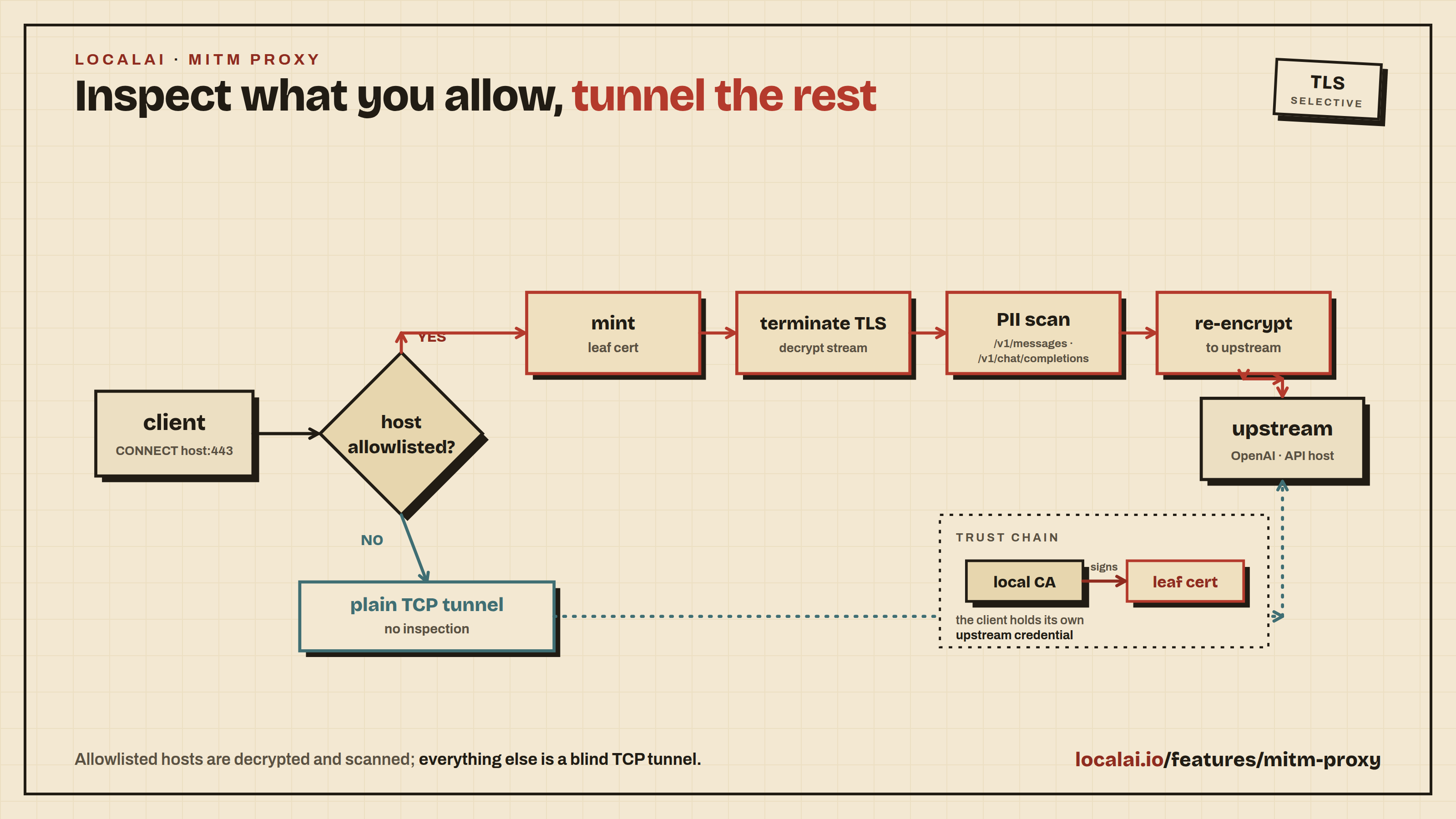
LocalAI can act as a local HTTPS proxy that redacts PII from your Claude
Code, OpenAI Codex CLI, or any HTTPS client without holding their API keys.
The proxy intercepts only the LLM API endpoints you allowlist (default:
api.anthropic.com, api.openai.com); everything else - OAuth, telemetry,
package fetches - passes through as a plain TCP tunnel.
Use this when:
You want to use Claude Code with a Claude Pro/Max subscription but still
apply the same PII redaction LocalAI applies to API-key traffic.
You run Codex CLI on a corporate laptop and need an audit trail of prompts.
You want LocalAI to enforce egress policies for AI traffic without
becoming the API endpoint clients talk to.
The proxy is off by default. Operators opt in by setting --mitm-listen
and distributing the generated CA cert.
How it works
The proxy generates a private CA on first start (persisted to disk).
Clients set HTTPS_PROXY=http://localai:port and add the CA to their
trust store (e.g. NODE_EXTRA_CA_CERTS for Node-based CLIs like Claude
Code and Codex).
The CLI sends CONNECT api.anthropic.com:443 to the proxy.
For allowlisted hosts, the proxy mints a per-host leaf cert signed by
the CA, terminates TLS, parses the HTTP request, applies the global
PII redactor on /v1/messages or /v1/chat/completions, and forwards
to the real upstream over its own TLS connection.
The streaming SSE response runs through the same pii.StreamFilter
the cloud-proxy backend uses.
For non-allowlisted hosts, the proxy is a plain CONNECT tunnel - no
TLS termination, no inspection, no CA trust required.
The CLI authenticates with its own subscription / API key as it normally
would. LocalAI never holds the credential - it just observes and rewrites
the request body.
Quick start
Start LocalAI with the MITM listener:
local-ai run --mitm-listen :8443
The first start generates a CA at <data-path>/mitm-ca/{ca.crt,ca.key}.
Restarting reloads the same CA so clients keep trusting it.
Configure Claude Code to use the proxy and trust the cert:
export HTTPS_PROXY=http://localhost:8443
export NODE_EXTRA_CA_CERTS=$(pwd)/proxy-ca.crt
claude
Now any claude chat session that touches api.anthropic.com/v1/messages
gets its prompts and tool inputs scanned by LocalAI’s PII filter, and any
PII the model emits in its streaming response is masked before reaching
your terminal. Events appear in the LocalAI middleware admin page under
Filtering → Recent events.
The same works for Codex CLI - set HTTPS_PROXY and NODE_EXTRA_CA_CERTS
and run codex.
Configuration
The proxy is enabled with two startup settings:
Flag / env
Default
Purpose
--mitm-listen / LOCALAI_MITM_LISTEN
empty (disabled)
Address to bind the proxy listener on
--mitm-ca-dir / LOCALAI_MITM_CA_DIR
<data-path>/mitm-ca
Where to persist the CA cert + key
There is no global intercept-hosts flag. The hosts whose TLS is terminated
and scanned are declared per model, in the model YAML mitm.hosts:
block. Each model that names one or more hosts owns those hosts; everything
not listed by any model tunnels through untouched. A cloud-proxy model that
should intercept Anthropic traffic looks like:
Hostnames are case-insensitive. Add custom upstreams (e.g. an
OpenAI-compatible third-party provider) by adding their hostname to a
model’s mitm.hosts: list and ensuring their endpoint paths match
/v1/chat/completions or /v1/messages. You can create these models from
the Add Model UI.
What gets redacted
The MITM proxy runs the same PII detection as the regular request
middleware. Detection is NER-based (a token-classification detector
model), not a fixed regex list: the older pattern tier has been removed.
See /features/middleware/ for how detector models, entity
groups, and the mask / block actions are configured, and for the
instance-wide default detector.
A block action returns HTTP 400 with error.type=pii_blocked to the
client. The CLI sees the rejection and shows it as a request error.
Events are persisted via the same pii.EventStore the rest of LocalAI
uses, so the /api/pii/events endpoint and the middleware admin page
include MITM events alongside direct-API events.
Security notes
The CA private key is the master credential. Anyone with read
access to <data-path>/mitm-ca/ca.key can forge TLS for any host the
proxy could intercept. The file is mode 0600; keep it that way.
The proxy listener accepts plaintext HTTP CONNECT requests - bind it
to localhost (--mitm-listen 127.0.0.1:8443) unless you’ve added auth
in front of the listener. There is no built-in API-key check on this
port.
The MITM CA is separate from any TLS cert LocalAI’s main HTTP API
uses. Installing the MITM CA grants trust only for traffic that flows
through this proxy.
The proxy does not pin upstream certificates; it trusts the system
certificate store. If your machine’s trust store is compromised, the
proxy is too.
TLS termination negotiates HTTP/2 by default (ALPN h2) and falls
back to HTTP/1.1 for clients that don’t speak h2. Modern CLIs (Claude
Code, Codex) and the Anthropic / OpenAI APIs all use h2.
Limitations
Only /v1/messages and /v1/chat/completions get redacted. Other
paths on the same host (OAuth, model listing) are forwarded verbatim.
No request-shape translation. The proxy assumes the request body
matches the host’s wire format; cross-shape forwarding is the cloud
proxy backend’s job, not the MITM’s.
No CA rotation in the MVP. To rotate, delete ca.key and ca.crt
and re-distribute the new cert to every client.
Cert pinning kills MITM. Neither Claude Code nor Codex CLI pins
certificates today, but a future SDK update could. If a CLI starts
refusing the proxied handshake, that’s the signal.
Comparison with the cloud-proxy backend
LocalAI ships two cloud-related proxy modes; pick by who holds the credential:
Cloud-proxy backend (backend: proxy-*)
MITM proxy (--mitm-listen)
Client config
localai:8080 as API endpoint
localai:8443 as HTTPS_PROXY
Holds API key
LocalAI
Client (CLI’s own auth)
Works with subscription auth
No
Yes (CLI uses its own login)
Request rewriting
Yes (handler controls it)
Yes (selective per host+path)
CA cert distribution
Not needed
Required on every client
Routes through LocalAI’s auth/usage tracking
Yes
Yes (per-correlation-id events)
For shared deployments where LocalAI owns the API key and clients are
unsophisticated (curl, simple webapps), use the cloud-proxy backend. For
“give my Claude Code a privacy filter” use cases, use the MITM proxy.